
Susquehanna County Court Records After Arrest
After a jail arrest in Susquehanna County, the court record is often more stable than a custody record for formal charges. The receiving jail may record the arrest reason or commitment paperwork, but the prosecutor and courts decide what appears as filed charges. Susquehanna County's District Attorney's Office states that the DA is the county's chief law enforcement officer and prepares and conducts criminal cases in the Court of Common Pleas. The current DA listed in the research is Marion O'Malley.
The Clerk of Courts is the local criminal-file office. Its duties include criminal, juvenile, miscellaneous, and administrative case files, subpoenas, bench warrants, bail bonds, disposition reporting, appeals, fines, costs, restitution, and expungements. That makes the Clerk of Courts important when a docket sheet is not enough or when older file access is needed. For custody and booking details, the Susquehanna County inmate records page covers the no-roster search path; for booking photos, use the Susquehanna County jail mugshots page.
Find Susquehanna County Court Records After Arrest
The main online channel is Pennsylvania UJS Case Search. It is statewide and free, and it can search Susquehanna County cases by several identifiers that may appear on court papers, jail paperwork, or police paperwork. UJS docket data may lag the court office, and Pennsylvania courts warn that docket sheets are not criminal-history background checks.
- Open UJS Case Search and choose a useful search type, such as Participant Name, Docket Number, OTN, Complaint Number, Incident Number, Citation Number, or Date Filed.
- Set County to Susquehanna or Judicial District to Susquehanna - 34 when the case is local.
- Use magisterial district criteria for early proceedings or Common Pleas criminal criteria for cases held for court.
- Open the docket sheet and review charges, bail entries, warrants, court events, dispositions, sentencing, and cross-references.
- Contact the Clerk of Courts if a public docket is incomplete, delayed, limited-access, or not enough for the record needed.
The UJS Case Search portal displays the statewide search choices used to locate Susquehanna County court records after an arrest.
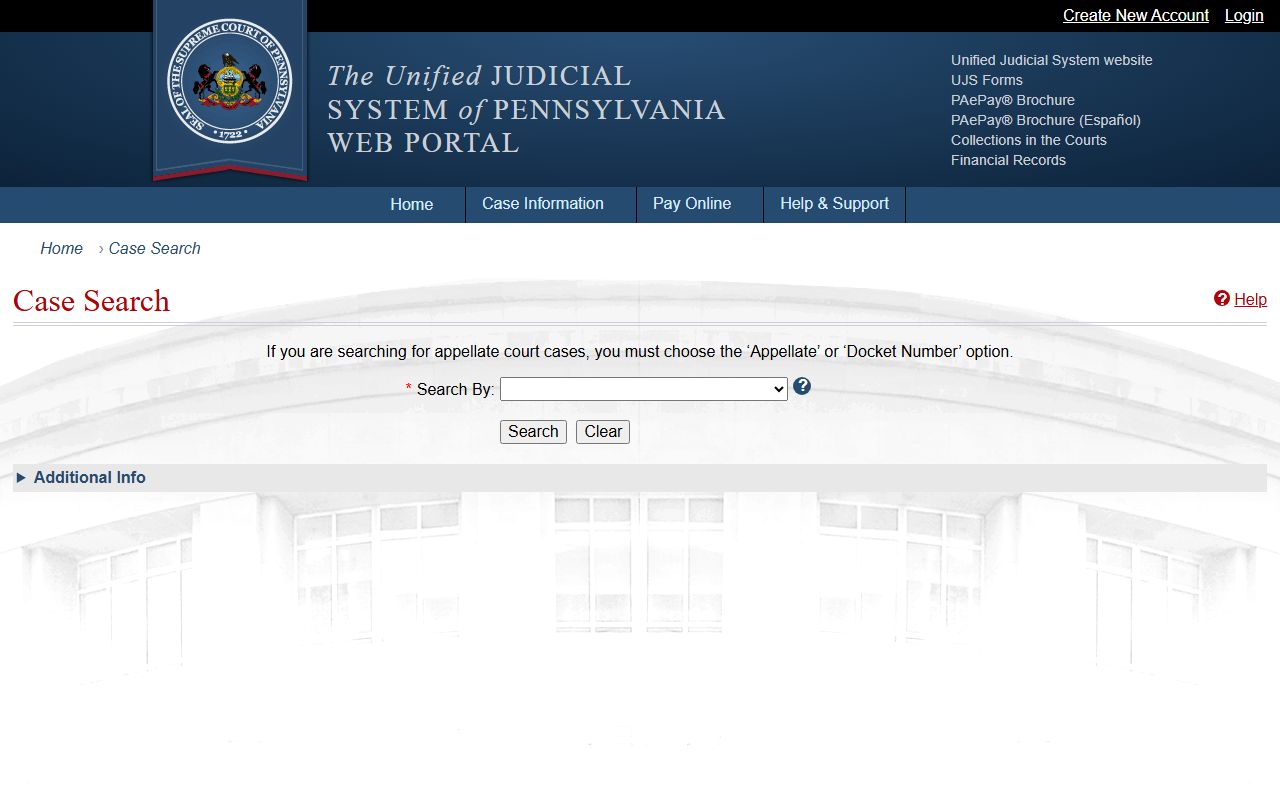
The screenshot is relevant because OTN, docket number, participant name, county, and judicial district are often more useful than a jail roster for formal charge tracking.
UJS Fields for Susquehanna County Arrest Records
UJS offers many search paths, but the best field depends on what is known. A person name is a broad start. An OTN can connect arrest and prosecution events. A docket number is strongest when copied from a notice, complaint, court order, or prior search result. Date filed and county filters help avoid matching the wrong person in another Pennsylvania county.
| Field | Use | Notes |
|---|---|---|
| Participant Name | Search by defendant or party name. | Use county and date limits for common names. |
| Docket Number | Find a known CP or MJ docket. | Best when copied exactly from court papers. |
| OTN | Track the offense number tied to the arrest. | Helpful when booking papers or police papers list it. |
| Complaint or Incident Number | Match police or complaint paperwork. | Useful when the case is still early. |
| County | Limit to Susquehanna County. | Use Susquehanna for local court records after arrest. |
| Judicial District | Limit to Susquehanna - 34. | Helps separate local cases from statewide results. |
Charges Filed After Susquehanna County Arrest
A charge listed at booking is not always the charge that controls the court case. Pennsylvania criminal matters may begin with a complaint, move through a preliminary hearing or waiver, and then proceed to a prosecutor-filed information in Common Pleas when held for court. Charges can be added, reduced, dismissed, amended, or resolved by plea, trial, ARD, withdrawal, or sentencing.
| Document | Who Uses It | What It Means |
|---|---|---|
| Criminal complaint | Police or prosecution at the early stage | Starts many Pennsylvania criminal cases and lists initial allegations. |
| Information | District Attorney in Common Pleas | Formal prosecutor-filed charges after preliminary-stage proceedings. |
| Indictment | Grand jury or prosecution route when used | Less common in routine local cases, but still a charging document type. |
The District Attorney's role explains why jail paperwork and court records can diverge. A receiving jail may handle custody while the Susquehanna County prosecutor files, changes, or resolves charges in the court record.
Susquehanna Court Charge Status
Charge status tells where the court record stands after an arrest. A pending charge is not a conviction. A dismissed charge is not the same as an expunged record. A bench warrant can appear when a person misses court or fails to comply. A bail or detainer entry can explain why a person remains in custody even when a money amount was posted or a local charge looks resolved.
| Status | What It Means |
|---|---|
| Pending | The charge remains open and no final outcome has been entered. |
| Held for court | The case moved from the preliminary stage toward Common Pleas prosecution. |
| Amended or reduced | The formal charge changed from the original arrest or complaint entry. |
| Dismissed or withdrawn | The charge did not proceed in that form, though the docket may still be visible. |
| Disposition entered | A plea, verdict, ARD, sentencing, or other final action appears on the docket. |
Bail Entries After Susquehanna County Arrest
Susquehanna County's bail page explains two local paths. A surety can sign the bond with the defendant and become liable for the full bail amount if the defendant fails to appear or comply. A third party can also deposit money for the defendant, but under that option the defendant is treated as the depositor and surety for refund purposes. After full and final disposition, the page says refunds are made within 20 days, less a $40 nonrefundable poundage.
| Bond Issue | Local Meaning |
|---|---|
| Surety | Signer accepts possible liability for the full bail amount. |
| Deposit for defendant | Money is posted, but the defendant is treated as depositor and surety. |
| After-hours magisterial bail | County inmate coordination directs callers to 570-465-9111 for non-business or holiday magisterial bail. |
| Detainer or hold | Another court, probation, parole, state DOC, ICE, or federal hold may prevent release. |
The county bail page is local to Susquehanna and should be checked before assuming a partner jail controls all release steps.
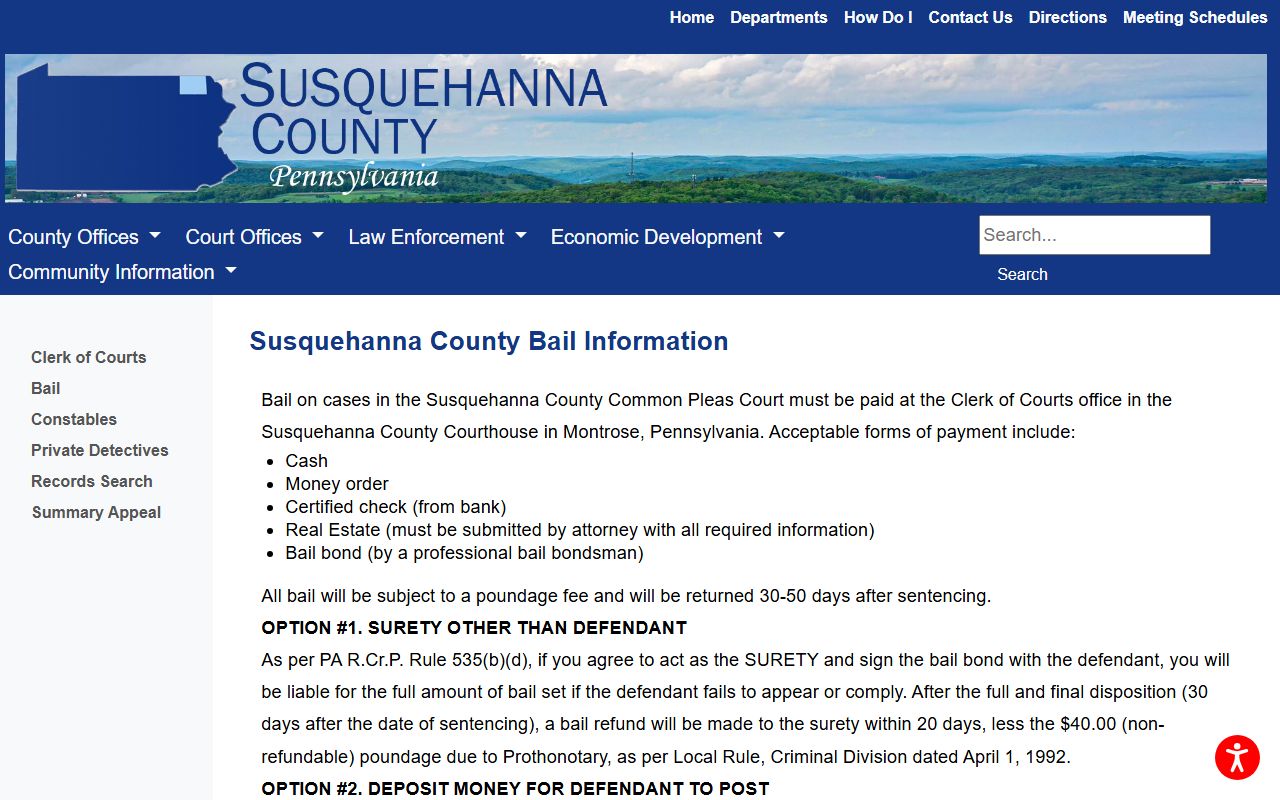
This is especially important because a person may be housed outside the county while bail and court entries remain under Susquehanna County court control.
Warrants Before or After Arrest
The Susquehanna County Sheriff publishes a CountySuite Warrant Portal for active bench, probation, and sheriff warrants. The sheriff says it makes every effort to keep the list correct and remove names after apprehension or vacation of the warrant. The portal fields include name filter, local-warrant checkbox, date type, start date, end date, filter, and clear. Results show name, age, last known address, offense, classification, and date issued.
The sheriff's warning is part of the record context: never attempt to apprehend a wanted person. Call the sheriff at 570-278-6650 or 570-278-6652, or call the Emergency Dispatch Center after hours at 570-465-9111. For probation warrants, the sheriff page points to Adult Probation at 570-278-5930 or after-hours dispatch at 570-465-9113.
Charges vs Convictions
A court record after a jail arrest may show serious allegations before any conviction exists. Pennsylvania courts publish docket data, but the presence of a charge, warrant, bail entry, or hearing does not prove guilt. The docket must be read through the current status and final disposition fields.
| Charge | Conviction | |
|---|---|---|
| Stage | An accusation or filed count after arrest. | A guilty plea, verdict, or other conviction outcome. |
| Where It Appears | Complaint, information, docket sheet, or court event. | Disposition and sentencing entries. |
| Can Change | Can be amended, reduced, dismissed, or withdrawn. | Can be appealed or later affected by post-conviction relief. |
Sealed and Expunged Arrest Records
Pennsylvania criminal history access is governed by the Right-to-Know Law, court access rules, and CHRIA. The research cites 18 Pa.C.S. Chapter 91 and 18 Pa.C.S. § 9122 for criminal-history dissemination and expungement. A limited-access or sealed record may be hidden from normal public search. An expungement is a court-ordered remedy for qualifying criminal history records. Juvenile matters, active investigations, victim or witness safety, privacy issues, and noncriminal private data can also limit public access.
| Sealed or Limited Access | Expunged | |
|---|---|---|
| Public visibility | Restricted from ordinary public view. | Removed or destroyed as ordered by court. |
| Authority | Court access law, limited-access rules, or protective order. | 18 Pa.C.S. § 9122 when eligible. |
| Best next step | Check the court office that handled the case. | Obtain and serve the court order through the proper agencies. |
Public Access and Background Checks
The Pennsylvania courts docket-sheet guidance warns that docket sheets are not a substitute for criminal-history background checks. The Criminal History Record Information Act controls official criminal-history dissemination, and 18 Pa.C.S. § 9121 addresses how criminal-history information may be released. For employment, tenant screening, credit, insurance, or other regulated decisions, use legally compliant consumer-reporting channels rather than a casual docket search.
Important: Court docket details may lag court filings and may not show limited-access records, so verify with the originating court office.
Public Record Search
Sponsored Results